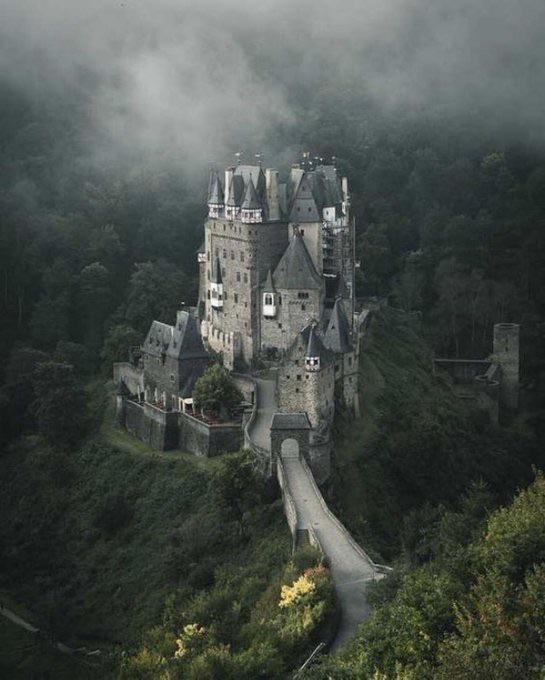
Germany has more castles than the United States has McDonald’s. This is the Eltz castle, located in Wiershem. It has been owned and occupied by the same family for 33 generations over 800 years
I'm German and I still don't believe. That has to be a very strange definition of a castle??
Edit: Okay turns out it's just dumb click bait, the definition of "castle" in this case includes everything from a fancy residential house that has been used by aristocracy in the past, to a proper castle and even ruins of a castle or a memorial. (Burg, Schloss, Ruine, "Herrenhaus", Denkmal).
Edit 2: According to the European Castle Institute there are 25000 castles in Germany, of the type like in the picture. Guess what... around 20% are still or at least somewhat resembling a building, 40% are ruins and
the remaining 40% are preserved only as "archaeological monuments" in their foundations - or have disappeared.
Yes castles that have fully disappeared and nothing except the location is still known also count into the 25000.
In reality there are around 5000 castles in Germany, still impressive but most are not as impressive as in the picture at all, and around 13000 Mc Donald's in the USA.
When I went to Ireland. I saw the ruins of a castle and asked a local what castle it was, he said, "I don't know." It's just an old pile of rocks" That's when I understood that castles in Ireland were like barns in New England. You see some truly spectacular specimens, and then you have a bunch that barely qualify as buildings. And then you have the ones that are just piles of rubble. Fewer of those because it's a lot easier to get rid of a pile of wood than a pile of rocks.
I'm from Ireland, and I never really considered this before. I read that comment and thought 5k castles was a shit ton, and so I went and looked up how many we have. Apparently it's over 7000, and is around 30k if you include partial ruins and fortified estate buildings. I've never really paid much attention to them because they're just part of the landscape, or an old building at the center of a town. I guess we don't really have many truly impressive ones like there are in other parts of the world, so it was never worth paying attention to. Honestly, we also weren't particularly fond of the people who would have lived in those castles.
And even Schlösser are hardly a solid definition. I took the bus that went past Schloss Essling for years before someone mentioned to me that that decrepid old house is a Schloss. I would have never guessed.
Btw, English does have terms that differentiate: Fortress = Burg, palace = Schloss. But castle means both.
English very much has terms to differentiate these, it is just Americans don't use them.
Castle is a catch all term for a fortified building containing a keep or keep like structure and at least one defensive wall, that was the seat of both military and civil power in the middle ages.
A fort is a fortified building that was only the centre of military power and is normally used from the Elizabethan age onwards.
Fortified manor houses are buildings that are secure but don't have the thick walls or curtain wall of a true castle.
A manor, stately home or palace is just a very big house.
One of the issues is that Victorians (especially in Scotland) liked to put a turret or crenellations on their houses and call them a castle to make it sound fancier than it was.
It's also complicated that in my experience, castles are usually damp, draughty and cold to live in. As soon as the Thirty Years War ended, and there was less need for a fortification and when any family got some money; the first thing they'd do is build a nice new palace with all modern conveniences, usually using the bricks of the old castle.
Since the palace was often literally built of the old castle, it often kept the name.
well that's basically a "manor" in English and is very much not considered a "castle". to call those castles in English just sounds like bad translations work.
Germany also had lots of "Zollfestungen". Those were fortified towers at rivers with a chain spun across the river and if you wanted to pass you had to pay a toll.
Those things are also considered as castle in english and there were maaany of these in Germany as it was splintered down to small kingdoms before which means there were many borders.
One every 5x5 km doesn't sound unreasonable in some areas though.
We were part of the patchwork of little states here in the Eifel and the allegiance would change from village to village. We still have "Catholic" villages and "Lutheran" villages and notable differences in dialect to the initiated. Every other town seems to have a Schloss or Burg lol.
It really isn’t. They’re including many small fortifications that no one would consider a “castle”. Things like small battlements that would have been manned by fewer than 10 people… they’re really stretching the definition of “castle” to get there
Just a note that Schloss is the word Germans normally use for castle, and that word covers everything you would call a castle in english, and a also huge number of other buildings that would have different names in english. Palaces and country houses are all schloss, for instance. So there are probably nowhere near as many Disney style castles as there are maccyDs in the US. There are a lot of palaces and big houses in Germany though.
I mean there are many different words that can be applied to these buildings, depending on what they are, what their function is etc.
Between synonyms or similar words like Residenz, Anwesen, Sitz, Palast or Kastell, you can always combine nouns to describe it better.
Is the castle used for hunting trips or other recreational activities? Visit your Jagdschloss or Lustschloss. Need a retreat during the hot summer months? Visit your Sommerresidenz.
So yeah there are multiple words, but for normal conversations the difference between Burg and Schloss is enough.
We have both Burg and Schloss as common terms for castle, Burg would be used for your typical medieval fortress castle and even fortified settlements. So it's always some sort of fortification. Schloss as you said may refer to many kinds of noble homesteads, which might be a Burg, but also includes non-fortified places like Palaces and grand manors. But it's actually more of a modern thing that these two words have settled in such clearly defined different meanings.
There are also many other terms for things like castles and fortifications, like Kastell which is very similar to castle.
A Schloss is a more fancy castle, like Neuschwanstein or Sanssouci. They probably included everything that is more rustic, which is called a Burg, and fortresses, which are Festungen. And if ruins are included then the number is probably in the tens of thousands.
Yes, I didn't want to come across angry about it, but in my experience (as someone who moved to Germany) when Germans translate schloss into English, they always use the word castle, and as lovely as all those buildings were, I was always a bit disappointed about the complete absence of defensive structures.
I actually think palace is a more accurate translation for Schloss, as in Buckingham Palace = Schloss Buckingham and on thr other hand Windsor Castle = Burg Windsor.
In German you'll find the number of 25000 "Schlösser, Burgen und Ruinen". So this includes the defensive castles (and later imitations like Neuschwanstein), but also all kinds of palaces, and ruins. This will include many buildings that are more like manor houses that were build by some minor nobility and ruins where there are only a couple of stones, maybe even only some earthworks left. And by that count you can get to these 2-3 castles per municipality more easily.
So it's click bait then. Using a vague term that covers multiple style of structures instead of one specific type that the rest the world considers a castle.
They're undoubtedly just using an insanely broad term and counting everything that remotely applies. A pile of rubble that's been designated the site of a castle centuries ago probably still counts, for example.
Keeping it warm is difficult, but keeping it properly maintained is probably even more expensive. And at least in Germany, you are legally required to maintain old buildings
Many are open to the public, selling tickets to visit the place. Thus, raising money for the upkeep.
Those which are closed to the public - a lot of private money flows into the place. A friend of mine is a countess, with her and her family still living in the centuries-old castle. A lot of the money they earn in their jobs goes to the upkeep, along with rooms of the castle they rent off for events, weddings and such. In her case, it's a question of responsibility for the following generations of the family. They've all got pretty decent jobs, but they aren't that rich money-wise. I know they had to sell off some heirlooms to have the roof fixed.
Other families just have been filthy rich for centuries, and their passive income pays for their House.
Seems like less than a thousand are open for regular public access, which makes sense - if you’ve seen a thousand castles, you’ve seen them all, I imagine.
So that leaves a lot that need to be supported privately.
I know a person that had a villa in southern France by inheritance. It was affectionately referred to as "The White Elephant" in English. They were never happier than when it was sold after significant restoration that took decades.
A second person I know bought the equivalent in the US and they weep about the upkeep as well, but make a modest income as it's mainly restored with all of their free time.
It's weird how people fall in love with a property then commit their lives and a significant portion of their incomes to historical buildings.
Are they legally obligated to keep the structure in its original material and interior design? Can they retrofit modern insulation, waterproofing, and adjust the interior so it's more like a modern home?
What's the major maintenance item for such castles?
Are they legally obligated to keep the structure in its original material and interior design?
Depends on the country. It's not unheard of that you need to fit some council or departments old expensive construction methods. Replace oak beams with oak beams ,etc
Not only that. You are obliged to do it in the exact way that the cultural heritage office tells you.
Install modern windows - nope
Install prper insulation - nope
Install AC - nope
I bet there are still "castles" you can get for 1€, but will cost millions to make inhabitable. There used to be a lot after reunification that nobody wanted - not even for free.
Why do you think so many castles had large tapestries on the walls? They where basically carpets you'd hang to help retain the heat in the room.
Biggest issue however isn't heat. That's what the fireplace is for. It's the maintaining that much volume of space. Between dirt, water, wind, and just plain volume of area... There's a reason why you'd need staff on hand just to. Maintain it... Or have whole wings closed off you don't go to since it's unmaintained due to cost.
Why do you think so many castles had large tapestries on the walls? They where basically carpets you'd hang to help retain the heat in the room.
Some castles also had rooms with wooden walls and lower ceilings that were easier to heat. Often those wooden panels didn't survive the centuries though. The appearance of castles today may be very different to actual medieval life.
I wish John Dunsworth (Jim Lahey from Trailer Park Boys) got to live in a castle.
Towards the end of his life he lived on the coast, slowly rebuilding and reinforcing masonry structures. Seems like he would have had a lot of fun fixing up a castle he got to live in.
In Germany, people sometimes give away their castles for free. The reason is that they are protected heritage sites (Denkmalschutz), so you are not allowed to tear them down and use the land for something else. You are also not allowed to change or modernize anything without special permission and you are required by law to keep them intact which costs a fortune.
I actually lived in one of the villages right below this castle and my school was right beside another castle a few villages away. One of my friends also works at yet another castle close by.
The yearly canon-salutes were so impressive that our school cancled all our lessons that afternoon so we could go watch it.
And on top of my head I know of close to 15 other castles there and in my current city, yea, there are a few.
I went there last month. Their cannoneer unfortunatly died because of COVID. Ever since they don't have anyone who is able to maintain the cannons. They are hiring, if anyone is interested.
Since it has been years since I last visited, I didnt know that. Thats actually really sad, it was one of the coolest things I saw as a child. We could see the cannons from some of our classrooms.
Germany has an estimated 20,000 to 25,000 castles, palaces, and fortresses (Burg and Schloss). This includes everything from grand medieval hilltop ruins to famous fairy-tale landmarks like Neuschwanstein Castle
The castle was founded around 1157. Amazingly, it has remained under the unbroken ownership and care of the House of Eltz for over 800 years, spanning 34 generations. Today, the family preserves it and keeps parts of it open to the public.
In 1268, three brothers of the Eltz family had a dispute and decided to split the estate. Instead of building three separate castles across the region, they shared the fortress.
"This includes everything from grand medieval hilltop ruins to famous fairy-tale landmarks like Neuschwanstein Castle"
You just named two things at the same end of the spectrum. It also includes barely discernable rock piles and countryside homes that happened to have a fence.
Yes, there are many many amazing castles and forts in Germany, more than most would think, but you imply they are all majestic while many were simply a small keep at a crossroads garrisoned by like 4 people
I don't know where you live in Germany. But in my area, every city has at least 2–3 castles, and there are many more in the surrounding towns. Yes, they aren't as majestic as Neuschwanstein. But they are essentially what a castle truly was in medieval times, like this one.
"In fact, only perhaps 20 percent of the castles in Germany still have a roof on them, according to the EBI director. Another 40 percent are in a state of ruin, while the remaining ones often exist only as "ground-level monuments" in which only the foundations — if even those — are still evident."
Oh there are definitely thousands of proper castles in Germany, I make that point in my comment. But in OPs count of 20k-25k, for every proper castle, there are 5 that were a four man keep at a crossroads or a wooden palisade near a manor.
I think the count of true castles/forts is closer to 8k, which is still unreal. But to get the figure above the "McDonalds" in USA number OP had to loosen the definition and I'm just making that point
I see your point, but i am sure you can also find a small mc Donald's at a crossroads staffed by like four people and the comparison is kinda hilarious to me.
That number of 20,000 to 25,000 will include a lot of places that will not pass the eye check of most people to recognize whether it’s a castle. A lot of these will be some weathered ruin of a single wall or a slightly fancy but still quiet normal house, certainly very far from a place like Eltz.
Apparently about 40% of them are ruins and another 40% are essentially just traces in the ground. But even if you only count the intact ones and the ruins and ignore the ones that are just lumps and bumps in the ground, we're still very slightly ahead of the US's number of McDonald's...
I would assume that the House of Eltz remains fairly wealthy? Or is it more a situation where the value of this amazing property just accrues so much over time that their ownership in and of itself is tremendous wealth?
I recall that it's not uncommon for noble families in other countries to basically become incapable of affording the castles they've inherited over time because no money is coming in.
I've been there! You can go inside but can't take pictures as people still actually live there. It's absolutely breathtaking and was one of the best parts of my trip (though the whole country was incredible honestly). The castle is super tall but you can't see it until you're up close because it's in the center of a deep valley surrounded by tall hills. This is also one of the reasons it's stood (mostly) undisturbed for so long
I heard that the Holy Roman Empire had an unofficial rule that there should be a castle at least within a day's horse-ride (or was it just foot-travel) everywhere in the land .
I don't think it's that insane if you consider the age of Germany/the amount time poeple haved lived in the geographical area of Germany, compared to the age of McDonald's.
"On 26 July 1184, in the German city of Erfurt, approximately sixty local nobles died when the floor of a building collapsed through the ground floor and into the latrine cesspit below. They were attending a Hoftag ("court day") conducted by King Henry VI when their combined weight caused the floor of the building to collapse. Some of the attendees drowned in human waste after falling into the cesspit."
One privillige I envy these types of families for is that they knew what their ancestors were like. I wish I knew what were my ancestors doing 200 years ago. But to know up to 800? Crazy
There is still one Roman family that traces its roots back to an actual senator of the Roman Empire, Quintus Fabius Maximus Verrucosus born in 280 BC. Just 2000 years later (1935 ) the head of the family was the cousin of Victor Emmanuel III of Savoy, King of Italy
Would have probably been my reaction if I wouldn't live 30 minutes from that thing. I've been there. Its real. And it's a shame that Eltz comes up every now and then while there are dozens of other cool castles around.
Well, Eltz Checks every box and they s a prototype castle. But there are a lot of other cool ones around.
If you ever visit Eltz, visit me in Koblenz. Schloss Stolzenfels and Festung Ehrenbreitstein are a must!
One of our favorite family trips! Rented a car in Frankfurt, drove from Koblenz to Koln up the Rhein for castle peeping. Highlight was staying the night at Schönburg and walking the battlements at night with a massive fog cloud blanketing the valley.
It's due to the fact that castles were an obsolete technology before Columbus was born.
But really it's a comparison category not a slight at the US castle or McDonald's building prowess.
Our castles are basically the one thing that makes visiting this country worth it imo. That and some of the nice forests we have here. The rest is pretty meh from a tourist perspective IMO.
Pretty impressive not a single generation screwed things up and had to sell. Imagine the amount of money spent over that time upgrading and upkeeping that property.
Wildly misleading. I travel to Germany a lot. Going back next week. There are not tens of thousands of these.
There are thousands of things called Schloss, which often resemble no more than a nice house. You will not find tens of thousands of what-we-typically-think-of-as castles there.
Schloss translates as Castle yes. Schloss sanssouci and Schloss neues in Potsdam are incredible. Schloss also translates as manor or chateau and like I said is often used for much smaller places
Spent last summer hiking through Wales.
Castle galore. It was amazing.
There's a castle (can't remember the name) that's near a river so you can just put your things inside the yard and go through a small tunnel and go for a swim.
We did something like 6 castles in the first day, just walking.
JUST IMAGINE the types of artifacts that could be tucked away in the cellars here. One of my favorite mental rabbit holes. Aristocratic families who have maintained possession of a property for hundreds and hundreds of years - what do they have in those vaults??
Nazi stuff, gemstones and diamonds, bearer bonds, pieces of the Amber Room, loot taken across hundreds of years of European history, colonial loot ranging hundreds of years, Mengele's research, many of the missing or lost books/manuscripts. Imagine the access an incredibly rich historically steeped family would have to things like this.
This part of Germany gave me Tolkien vibes partly because a nearby area was called Gondorf, but also because this castle is nestled by a ring of hills taller than it giving the impression of a miniature version of Gondolin.
Germany has history way before we europeans conquered america, so its no wonder. Everyone should visit europe and the history places, some are magneficent




6.6k
u/Otaraka 21h ago
About 14k McDonalds for those of you are also wondering. I thought they had to be exaggerating at first.